
Fair Trade vs Direct Trade Coffee: Which Is Actually Better
Last Updated: November 2, 2026
Quick Summary
Fair trade coffee is not automatically better; it guarantees a price floor, social premium and audited labor standards, but it is a process guarantee rather than an outcome guarantee. Cup quality depends on variety, altitude, processing, freshness and roast, not the seal. Judge a bag by a named certifier, named cooperative, roast date and long-term buyer relationships.
- The cooperative, not the individual farmer, holds the fair trade certificate.
- The social premium belongs to the cooperative and is voted on how to spend.
- Certification verifies a floor and premium were paid, not that every household gained.
- Compare coffees with the same dose, grind, roast level and roast date.
- A printed roast date and named origin predict cup quality better than any sourcing claim.
Table of Contents
- Fair Trade Coffee vs Direct Trade: The Core Difference
- Fair Trade Coffee Pros and Cons for Farmers and Buyers
- Farmer Pay, Premiums and Where Certification Costs Go
- Does Fair Trade Coffee Taste Better? What the Cup Says
- Fair Trade vs Organic: Overlapping Standards and Real Differences
- Sustainability, Climate Resilience and Long-Term Farm Viability
- How to Buy Ethically Sourced Coffee: A Shopper's Comparison Framework
- Choosing Your Next Bag at Reading Coffee
- Frequently Asked Questions
Fair Trade Coffee vs Direct Trade: The Core Difference
Fair trade coffee is a certification system that sets minimum prices, labor standards and premiums for smallholder farmers, verified by an independent third party.
Neither model wins outright. Here is where each moves money to farmers, where it falls short, and how to judge a bag on the shelf.
The Fair Trade USA agricultural standards define those requirements for US importers, and independent auditors check compliance rather than the roaster or the importer.
How Fair Trade Certification Actually Works
Certification runs through the producer organization, not the individual farmer. Smallholders form a cooperative, which applies for inspection, and an accredited certifier audits labor practices, record keeping and democratic governance.
The part most shoppers miss: the cooperative, not the farmer, holds the certificate. That structure builds bargaining power, but it also means farm-level benefits depend on how well that organization is run.
Where Direct Trade Diverges
Direct trade has no universal standard. A roaster negotiates price and terms one-on-one with a producer or estate, often visiting the farm. Traceability can be exceptional. Verification is whatever the roaster chooses to publish, which ranges from detailed contracts to marketing language.
Fair Trade Coffee Pros and Cons for Farmers and Buyers
The honest answer is that fair trade coffee pros and cons cut both ways. Farmers gain a price floor and collective bargaining power; buyers gain a verified labor standard. The cost is paid in license fees, paperwork and a premium structure that can lag behind specialty market prices.
| Factor | Fair Trade | Direct Trade |
|---|---|---|
| Verification | Independent third-party audit | Roaster's own disclosure |
| Price protection | Documented minimum price floor | Negotiated case by case |
| Premium | Fixed social premium | Variable, often quality-based |
| Governance | Cooperative-led | Producer or estate-led |
| Best for | Smallholders needing stability | Producers with capacity to negotiate |
Best for fair trade: smallholder cooperatives that want predictable income and shared community investment. Skip if: you are a producer already commanding high specialty prices through personal buyer relationships.
Farmer Pay, Premiums and Where Certification Costs Go
Most comparisons of fair trade coffee stop at "farmers get paid more." The useful question is which dollars reach a farmer's household, which stop along the chain, and how much depends on the cooperative running the program well.
The Three Pools of Money in a Certified Chain
- The minimum price. A floor paid to the producer organization when the commodity market falls below it. It protects against downside risk; it does not raise pay in high-price years.
- The social premium. A fixed amount paid on top of the price, separate from the bean cost, that the cooperative votes on how to spend, typically schools, processing equipment, water systems, or replanting.
- Certification and license fees. Charges for inspection, auditing, and use of the mark, deducted at various points along the chain rather than paid by the shopper as a separate line item.
A common pattern is that the premium is the most visible benefit and the least understood: it belongs to the cooperative as an organization, not to the individual farmer who grew the lot. Whether a member sees that value as a cash payment, a shared asset, or a service depends entirely on governance.
Who Actually Pays the Fees
Certification costs are not a single charge. They include the producer organization's initial and annual inspection fees, the cost of preparing records and internal control systems, and the license fees paid by importers and roasters who use the seal.
For the smallest cooperatives, the fixed cost of an audit is proportionally heaviest, a small organization pays roughly the same inspection bill as a large one.
How the Premium Reaches Individual Farmers
The distribution path matters more than the headline number. Three patterns are common:
- Direct distribution. The cooperative pays members a per-pound premium after the sale. Transparent, but it depends on accurate volume records.
- Collective investment. The premium funds a shared asset, a wet mill, a drying patio, a truck, that lowers per-pound costs for every member. The benefit is real but indirect and slow to appear.
- Services in kind. The premium pays for agronomist visits, seedlings, or credit access. Value depends on whether the services match what members actually need.
This is the gap between certification and farmer income that most comparisons gloss over. Price stability is not higher pay, and a social premium is not a cash transfer. When commodity prices spike, the floor becomes irrelevant and the premium is the only remaining benefit, which is why cooperative governance, not the seal, determines whether certification is worth it for a given farm.
What Independent Measurement Suggests
Certification bodies publish compliance data; independent researchers publish household outcomes, and the two do not always agree. Studies of certified cooperatives consistently find outcomes vary widely by region, crop, and cooperative capacity, some members see measurable income gains and price stability, others mainly collective investments.
That is why the strongest buying signal is not the seal alone but the combination of a named certifier, a named cooperative, and a buyer relationship long enough that the premium has actually been invested rather than announced.
Does Fair Trade Coffee Taste Better? What the Cup Says
No certification stamps flavor into a bean. The more useful answer separates the variables that determine cup quality from the label on the bag, then gives you a way to test the claim yourself.
What Actually Drives Cup Quality
Cup quality is set before the coffee ever reaches a certification audit. The dominant variables, roughly in order of impact:
- Variety and genetics. A Bourbon or Gesha lot and a commodity-grade blend are different products before farming practices enter the picture.
- Altitude and climate. Higher-grown coffee matures more slowly and typically develops more acidity and complexity.
- Processing method. Washed, natural, and honey processing produce distinctly different flavor profiles from the same cherries.
Certification governs how coffee is traded, not how it is grown, processed, or roasted. A certified and an uncertified bag from the same farm, harvest, and roast can be indistinguishable in the cup, and the reverse is also true.
Why Ethical Sourcing Can Still Correlate With Better Coffee
The correlation is real but indirect, running through consistency rather than the seal. Long-term producer relationships give roasters stable access to the same lots year after year, supporting iterative quality work, selective picking, processing experiments, cupping feedback, that raises a farm's baseline.
What that means for a shopper: the ethical sourcing model is a plausible proxy for care, but it is not a flavor guarantee.
How to Test the Claim Yourself
A side-by-side comparison takes about twenty minutes and beats any label claim.
- Control the brew. Use the same dose, grind, water temperature, and brew method for both coffees; any variable you change confounds the comparison.
- Compare like with like. Same roast level, same processing method, ideally the same origin. A light-roast certified Ethiopian against a dark-roast commodity blend tests roast level, not certification.
- Check roast dates. Both bags should be within two to three weeks of roast; stale coffee loses to fresh regardless of sourcing.
- Taste blind. Have someone else label the cups, and note acidity, sweetness, body, and finish before you look at either bag.
- Repeat. One cup is an anecdote; two or three sessions across different lots tell you whether a difference is real.
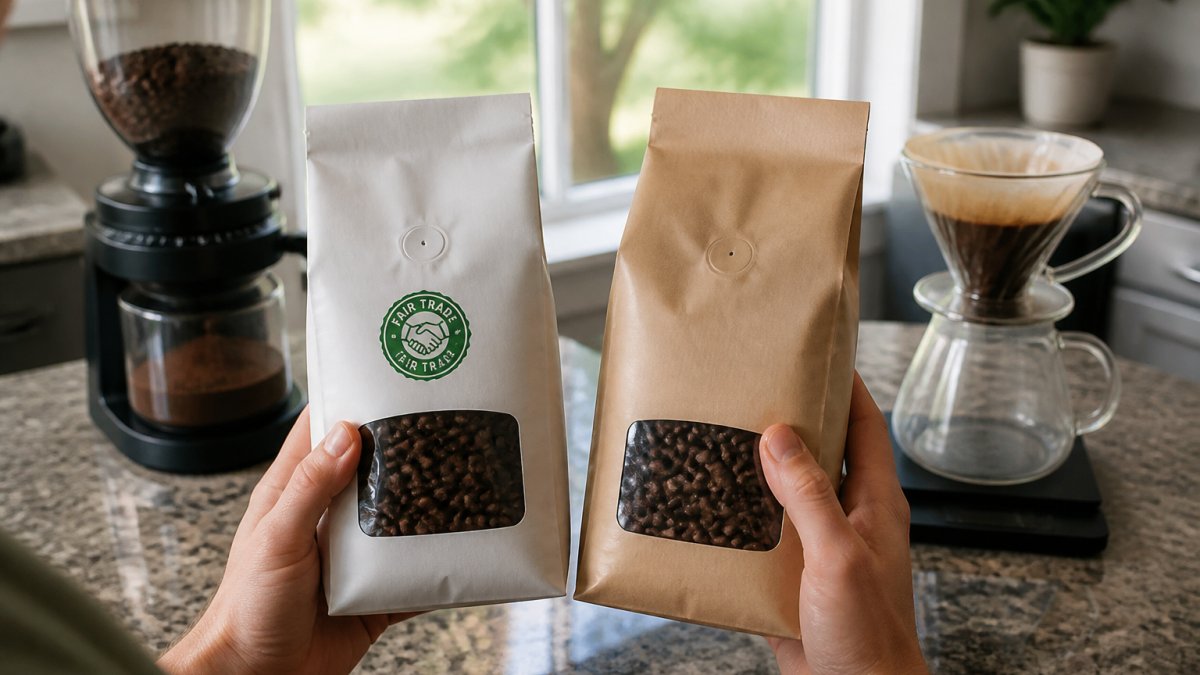
To run the comparison yourself, brew a traceable single origin side by side with a commodity blend and compare the finish. The difference you taste will come from variety, altitude, processing, freshness, and roast, not from the seal.
Fair Trade vs Organic: Overlapping Standards and Real Differences
The two certifications answer different questions. Organic certifies how coffee is grown: no prohibited synthetic pesticides, documented soil and pest management, annual inspection. Fair trade certifies how coffee is traded: price floors, premiums and labor conditions.
Layered together they cover farming practice and economic terms, which is why many cooperatives pursue both.
If you want to taste what a well-run certified supply chain produces, our Guatemala single origin from the Huehuetenango region is a clean, sweet medium roast that shows the difference altitude and careful processing make.

Sustainability, Climate Resilience and Long-Term Farm Viability
Climate is the pressure test for any sourcing model. Rising temperatures push suitable growing zones uphill, and smallholders carry the risk with the least capital to adapt.
Direct trade can move faster on the same problems when a roaster commits to multi-year contracts and pays for renovation upfront. Neither model fixes climate risk. Both improve the odds when the buyer stays for a decade rather than a season.
How to Buy Ethically Sourced Coffee: A Shopper's Comparison Framework
Use this four-step framework to compare any bag, certified or not. It takes about two minutes and cuts through most marketing claims.
- Check who holds the certificate. A named certifier with a traceable audit trail beats a vague "ethically sourced" claim every time.
- Look for the cooperative or farm name. Specific origin information signals real traceability; a country name alone does not.
- Compare price against the floor, not against competitors. A higher shelf price does not prove farmer pay, and a lower one does not disprove it.
- Ask how long the relationship has lasted. Multi-year commitments signal the long-term partnerships that actually stabilize farm income.
Choosing Your Next Bag at Reading Coffee
The fair trade coffee question has no single winner, and any roaster who tells you otherwise is selling, not sourcing. What we offer is transparency: our single origins run from $20 to $21 per bag, and our Pride blends at $19 send all proceeds to the Reading Pride Celebration. To go deeper into sourcing and brewing, you can book our Coffee Workshops.
Frequently Asked Questions
Is fair trade coffee actually better than regular coffee?
It depends on what you mean by better. Fair trade coffee guarantees a minimum price and a price premium paid to farmer-owned cooperatives, which supports farmer income and price stability. It does not guarantee a better cup. Coffee quality comes from variety, altitude, processing and roast, not the certification label. A well-roasted non-certified single origin can outscore a poorly roasted certified one. Treat fair trade as a sourcing claim, and judge taste separately by cupping the coffee yourself.
What are the pros and cons of fair trade coffee?
Pros: a floor price when the market drops, a premium paid on top, independent verification, and community investment through cooperatives. Cons: license fees and certification costs that smallholder farmers must absorb, a compliance burden that favors larger cooperatives, and no guarantee of higher cup quality. Fair trade also sets a floor rather than a ceiling, so in high-price years the minimum price does nothing and the premium is the only added benefit.
What is the difference between Fair Trade and Direct Trade coffee?
Fair trade uses third-party certification with published standards, audits and a minimum price. Direct trade skips the certifier and relies on the roaster's own producer relationships, often paying above commodity rates and visiting farms. Direct trade can move more money to a specific farmer, but the claims are only as good as the roaster's transparency. Fair trade is verifiable by an outside body; direct trade is verifiable only by how much the roaster publishes about who grew the coffee and what they paid.
Does buying fair trade coffee make a meaningful difference?
The evidence points to a modest but real effect. Studies of certified cooperatives generally find higher and more stable prices and better access to buyers, with the clearest gains in years when the commodity market falls below the floor. The difference shrinks when market prices are already high. Buying fair trade also signals demand, which shifts how much coffee buyers contract under certification. It is one lever among several, alongside direct relationships and paying more for quality.
Is organic coffee the same as fair trade coffee?
No. Organic certification covers how the coffee is grown: no prohibited synthetic inputs, with buffer zones and record keeping. Fair trade certification covers how farmers are paid and organized: minimum price, premium, cooperative structure and labor standards. A coffee can hold one, both or neither. Many specialty lots carry both, and the two labels answer different questions, so read them as separate claims rather than interchangeable ones.
Certification, premiums and price floors are complicated on paper and simple in the cup. Let us help you find the bag that matches your values and your brew method. Get started with Reading Coffee and taste what ethically traded, small-batch roasting actually delivers.
