
How to Source Sustainable Coffee for Your Cafe
Quick Summary
Sourcing sustainable coffee means choosing beans grown and traded in ways that protect farmers, the land and buyers. Start by setting your priorities and budget, compare Fair Trade and Direct Trade models, then verify certifications and traceability with a supplier scorecard.
- Pick the top two or three sustainability goals before comparing suppliers.
- Send every candidate roaster the same written request for information covering origin, pricing and certifications.
- Ask each supplier for certificate numbers and check them with the certifying body.
- Score suppliers from 1 to 5 on traceability, certifications, grower pay, documentation and taste.
- Compare cost per brewed cup, including freight and waste, rather than price per pound alone.
Table of Contents
- What Sustainable Coffee Means for a Cafe Menu
- Step 1: Define Your Sourcing Priorities and Budget
- Step 2: Compare Fair Trade and Direct Trade Coffee Sourcing
- Step 3: Ask Your Coffee Suppliers the Right Questions
- Step 4: Verify Certifications and Traceability Claims
- Step 5: Choose Sustainable Coffee Packaging and Waste Practices
- Step 6: Plan Wholesale Economics, Seasonality, and Continuity of Supply
- Lock In Your First Sustainable Coffee Order
- Frequently Asked Questions
What Sustainable Coffee Means for a Cafe Menu
Sustainable coffee is beans grown and traded in ways that protect farmers, the land and the people who buy them. For a cafe, it usually means three things: fair pay for growers, farming that keeps soil and shade healthy, and a supply chain you can actually trace back to a farm.
Sustainable sourcing changes what goes on your menu, not just your supplier list. A single-origin espresso from a named farm tells a story customers can taste and repeat. A generic house blend with no origin data gives you nothing to point to when a guest asks where the coffee came from.
Having clear answers builds trust and gives your staff something real to say at the counter.
- Fair pay: growers receive a price that covers production costs and a reasonable living
- Farm practices: shade growing, soil care and water use that protect the land
- Traceability: you can name the farm, region or cooperative behind each bag
- Packaging and waste: how the beans arrive and what happens to grounds after brewing
Step 1: Define Your Sourcing Priorities and Budget
Start by writing down what matters most to your cafe. Some owners put farmer pay first. Others focus on taste, organic growing or low-waste packaging. You cannot chase every goal at once, so pick the top two or three.
Then set a realistic budget. Sustainable green coffee often costs more per pound than commodity beans, so work out how that cost fits your drink prices. Check your current cost per cup before you decide how much room you have.
Watch out: a low price per pound can hide a weak supply chain. Ask what you are actually paying for before you assume a cheaper bag is a bargain.
Step 2: Compare Fair Trade and Direct Trade Coffee Sourcing
Fair Trade and Direct Trade are two common sourcing models, and they work differently. Fair Trade is a certification program with set minimum prices and premiums paid to farmer groups (Fairtrade Minimum Price and Premium Information). Direct Trade is a relationship model in which the roaster buys straight from producers, often at prices above certified minimums.
Neither model is automatically better for every cafe. Fair Trade offers a recognizable label that customers already know. Direct Trade can offer closer contact with farms and more detail about how the coffee was grown.
Reading Coffee works directly with global producers. Ask any roaster how often they visit or speak with the farms they buy from.
- Fair Trade: third-party certified, recognizable label, set price floors
- Direct Trade: relationship-based, roaster-to-farm contact, flexible pricing
- Best for: cafes that want a label on the menu versus cafes that want a farm story to tell
Step 3: Ask Your Coffee Suppliers the Right Questions
Most sourcing guides tell you to "ask questions." A cafe needs a repeatable way to ask, record, and compare answers so a wholesale decision is based on evidence rather than a friendly sales call.
Start with a written request for information (RFI) sent to every candidate roaster. Before you commit to a full wholesale order, you can request a non-flavored sample coffee to test on your own bar. Keep it to one page and ask for answers in writing so you can compare them side by side. A practical RFI for a cafe covers five areas:
- Origin and traceability: the farm, cooperative, or region; harvest year; lot or export record; and whether the roaster can name the producer for each offering.
- Price and farmer pay: the price paid to the producer per pound, how it compares with the commodity market, and whether any premium or quality bonus was paid. Ask for the pricing model in plain terms.
- Certifications and verification: certificate numbers for any third-party label, the certifying body, and the scope of the audit. Ask whether the roaster can share the certificate on request.
- Environmental and processing practices: shade management, water use, processing method (washed, natural, honey), and how the roaster handles packaging and shipping.
- Commercial terms: minimum order quantity, lead time, shipping cost and method, sample policy, and what happens if an origin is short.
Neither answer is automatically better; the point is to see which one matches your priorities from Step 1.
When you request samples, ask for the same roast level and the same intended brew method you will use on the bar. Taste with your team and record the results on the same scorecard you use for supplier evaluation (see Step 4).
Watch out: a supplier who cannot or will not put price and origin information in writing is telling you something about how much documentation you will get after you sign.
Step 4: Verify Certifications and Traceability Claims
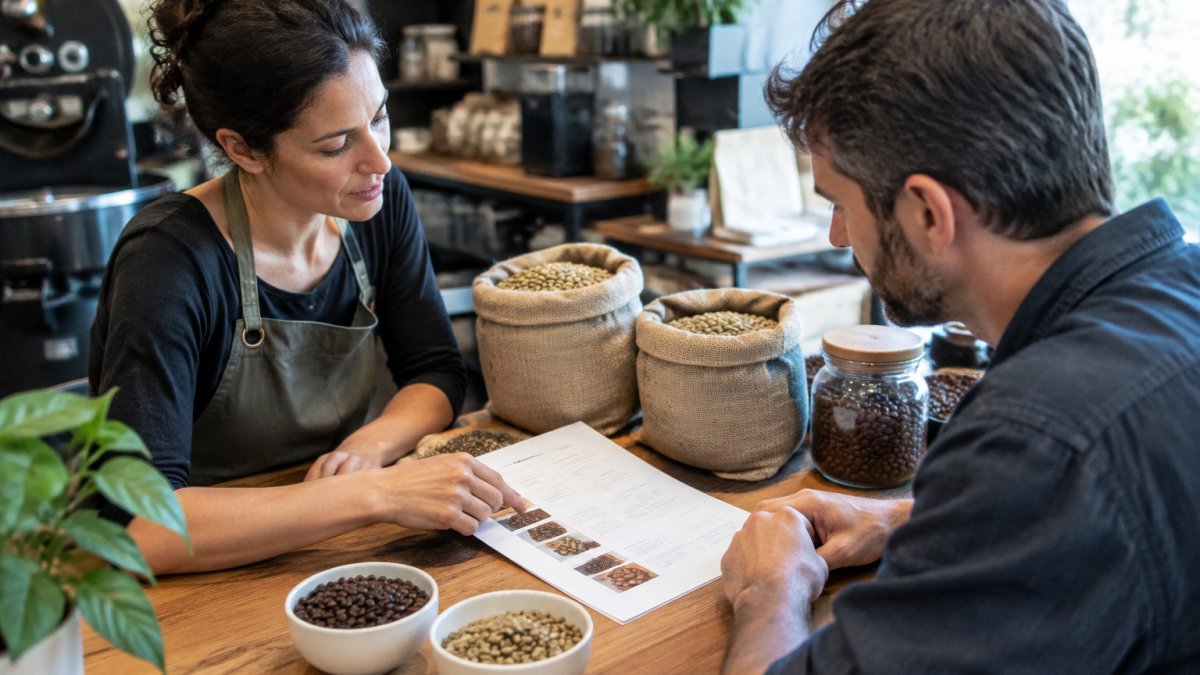
Certifications are useful, but they are not the whole story. Fair Trade, organic and other third-party labels come with audits and standards you can look up. Ask for the certificate number and check it with the certifying body. Many cafe owners find that a supplier who shares documents readily is easier to trust.
Traceability means you can follow beans from the cup back to a farm. Ask for lot numbers, harvest years and export records. If a supplier cannot tell you where a bag came from, treat any sustainability claim with caution.
Building a Supplier Scorecard
A simple scorecard helps you compare suppliers fairly. Rate each one from 1 to 5 on the factors that matter to your cafe.
| Factor | What to check | Score (1-5) |
|---|---|---|
| Traceability | Named farm or region | |
| Certifications | Valid, verifiable labels | |
| Grower pay | Price data shared | |
| Documentation | Lot sheets, export records | |
| Taste and consistency | Sample tested by your team |
Add up the scores after each supplier meeting and keep the sheets. Over a year, the scorecard shows which suppliers deliver on their promises.
Step 5: Choose Sustainable Coffee Packaging and Waste Practices
Sustainable sourcing does not stop at the bean. Packaging and waste add up fast in a busy cafe. Look for bags that are recyclable or compostable, and ask suppliers whether they use renewable materials. Bulk formats can cut packaging per pound, though they need proper storage.
Waste from the cafe itself matters too. Used grounds can go to compost, and single-use cups can be swapped for reusable options or paper alternatives where your customers accept them. Many cafes also brew only what they expect to sell, which reduces waste on the bar.
- Choose recyclable or compostable bags where available
- Set up a compost bin for spent grounds
- Offer a reusable cup discount to reduce single-use cups
- Track how much waste you produce each week for a month
Step 6: Plan Wholesale Economics, Seasonality, and Continuity of Supply
Wholesale economics decide whether a sustainable program survives its first year. Price per pound is only one line in the cost model. Build a simple total cost of ownership (TCO) worksheet for each candidate supplier that includes:
- Green or roasted price per pound and the price per brewed cup at your actual yield. A common starting point is 10 grams of dry coffee per 6-ounce cup for drip, but measure your own dose and yield rather than assuming.
- Shipping and delivery: freight cost, delivery frequency, and whether the price is FOB origin or delivered. A lower bean price with high freight can cost more per cup.
- Minimum order quantity (MOQ): how much cash you tie up in inventory and how long beans sit before use. Freshness matters, so a large MOQ can raise waste even when the unit price looks better.
- Yield and waste: dial-in loss, spillage, and stale inventory. Track a week of shots and batches to find your real yield before you compare suppliers.
- Menu pricing: the gap between cost per cup and what you charge. Sustainable beans often cost more per pound, so decide whether the difference comes from menu price, portion, or margin.
A practical way to compare is to calculate cost per brewed cup for each supplier at your real dose, then add freight per pound and an allowance for waste.
Seasonality and crop risk are part of the model, not an afterthought. Coffee is harvested in cycles by origin, and a single-origin menu can be disrupted by a short crop, weather, or shipping delays. Build continuity by:
- Keeping a backup blend or origin approved and sampled before you need it.
- Asking each supplier how many origins they carry and whether they can substitute a comparable profile.
- Reviewing your top two origins each quarter and confirming availability for the next roast cycle.
- Writing contract terms that cover lead time, substitution notice, and price-change notice so a short crop does not become a menu crisis.
Relationship models matter here too. Long-term purchasing commitments and transparent price terms can give a roaster and producer more stability, but they also lock in your cost.
Reading Coffee offers a breakfast blend in bulk volume for cafes that want a dependable everyday coffee, and a French roast in bulk volume for a darker, richer option. Compare the cost per cup, not just the cost per pound, before you lock in a contract.
Watch out: a contract that does not state lead time, substitution terms, and price-change notice leaves you exposed when a crop is short. Ask for those terms in writing before you sign.
Lock In Your First Sustainable Coffee Order
Start with a small trial order, taste every coffee with your team, and score each supplier on the same sheet. Sustainable sourcing is a long relationship, so choose a partner you can trust to answer hard questions. At Reading Coffee, we have spent more than 35 years building direct ties with producers and roasting in small batches in Berks County, Pennsylvania. Get started with Reading Coffee and bring a sustainable, traceable coffee program to your cafe menu.
Frequently Asked Questions
What is the difference between fair trade and direct trade coffee?
Fair trade is a certification run by third-party organizations that sets minimum prices and premiums paid to farmer cooperatives, and it is verified through audits. Direct trade is a buying model in which the roaster negotiates prices and terms straight with the farm or cooperative, often paying above fair trade minimums. Direct trade does not usually carry a formal certification, so cafes should ask for named farms, harvest years, and the price paid per pound. Many cafes buy both, using fair trade for consistent staple blends and direct trade for featured single origins.
How can a cafe verify that coffee is ethically sourced?
Start by asking the supplier for a traceability record that names the farm, region, and cooperative behind each lot. Then check whether certifications such as Fair Trade USA or USDA Organic appear on the bag or invoice, and confirm the certificate number with the certifying body. Request the price paid to producers and recent sourcing reports. A supplier that answers these questions in writing with specific details is generally more credible than one that relies on general sustainability language.
Is organic coffee more sustainable for cafes?
Organic coffee is grown without synthetic pesticides and fertilizers and must meet USDA National Organic Program standards to carry the label. Organic status addresses inputs but does not guarantee fair pay to farmers or low-impact processing. For a cafe, the strongest approach often combines organic certification with transparent pricing and traceability, because each standard measures a different part of sustainability.
What questions should cafe owners ask coffee suppliers?
Ask where each coffee is grown, which farm or cooperative produced it, and what price was paid per pound. Find out the minimum order quantity, whether the supplier offers a wholesale program, and how it handles roast dates and fresh-to-order shipments. Ask how it manages seasonal shortages and what happens if a featured origin sells out. Finally, ask for a sample, a return policy for batches that do not brew well, and documentation of certifications.
