
Benefits of Small Batch Roasting: 2026 Coffee Guide
Table of Contents
- What Small Batch Roasting Actually Changes in the Cup
- Small Batch vs Commercial Coffee: Where the Difference Shows
- The Impact of Roast Profile on Flavor
- Freshness of Coffee Beans After Roasting: Why Timing Matters
- Consistency, Cupping, and Quality Control at Small Scale
- The Trade-Offs: Environmental Impact, Equipment Limits, and Cost
- Frequently Asked Questions
Last Updated: September 27, 2026
What Small Batch Roasting Actually Changes in the Cup
Small batch roasting is the practice of roasting coffee in quantities small enough that a roastmaster can adjust temperature and airflow in real time, rather than relying on a fixed industrial program. The benefits show up in the cup: cleaner flavor separation, more defined origin character, and a roast profile built around a specific green coffee instead of an average of many.
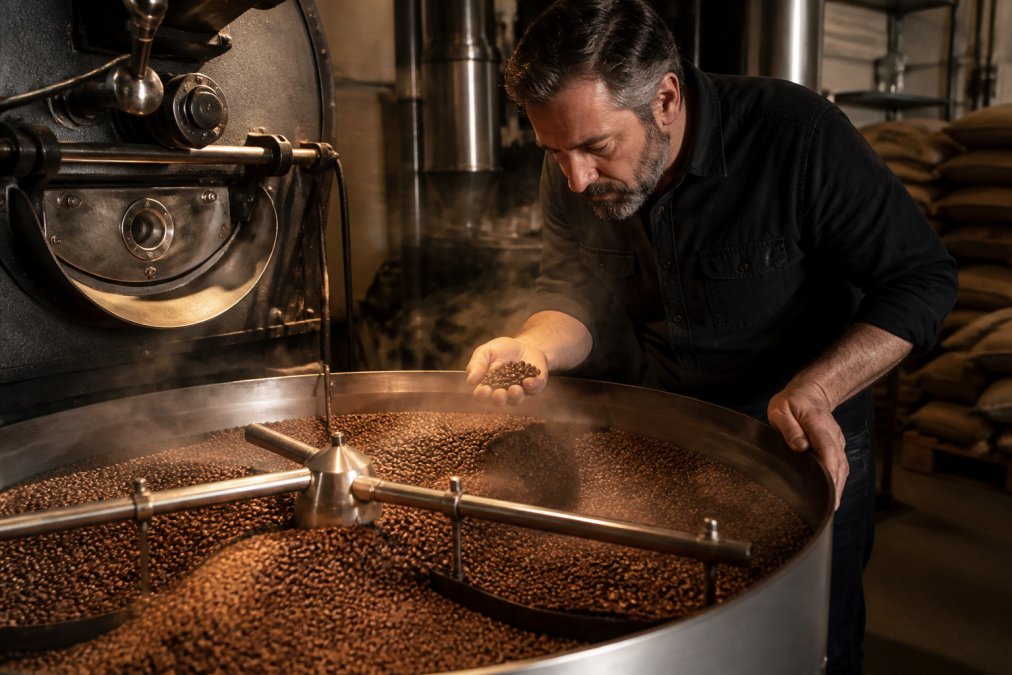
The core difference is batch size. A drum holding a few kilograms responds to a temperature adjustment within seconds; a commercial drum holding hundreds of kilograms carries so much thermal mass that the same adjustment takes minutes. The roastmaster's ability to steer a roast narrows as batch size grows.
What most guides miss is that small batch roasting is not automatically better. A poorly controlled small roast is worse than a well-controlled large one; the advantage only materializes when the operator watches the roasting curve and reacts.
Small Batch vs Commercial Coffee: Where the Difference Shows
Small batch and commercial coffee diverge on four fronts: batch size, thermal responsiveness, roast precision, and human judgment. Commercial roasting optimizes for repeatability across enormous volumes; small batch roasting optimizes for flavor clarity in a specific lot.
Batch Size, Thermal Responsiveness, and Roast Control
Thermal responsiveness is the speed at which a roaster's environment reacts to a change in heat or airflow. In small-scale production, that response is fast enough to correct a roast mid-development; in industrial roasting, the machine is locked into a pre-programmed curve.
That single constraint explains most of the downstream differences:
- Roast precision: small drums allow temperature adjustment in response to bean development, not just elapsed time
- Bean development: the roastmaster can extend or shorten development phase based on what the beans are doing
- Consistency: achieved through the operator's sensory analysis and cupping, not only through automation
- Batch size: smaller lots mean each green coffee can get its own roast profile
| Factor | Small Batch Roasting | Commercial / Industrial Roasting |
|---|---|---|
| Batch size | A few kilograms per roast | Hundreds of kilograms per roast |
| Thermal responsiveness | Fast, seconds to adjust | Slow, minutes to adjust |
| Roast control | Operator steers the curve live | Pre-programmed curve, limited steering |
| Consistency method | Cupping and feedback loops | Automation and fixed parameters |
| Best for | Origin character, single lots | Volume, uniform house blends |
Commercial roasting wins on cost per pound and identical output; small batch wins when the goal is to taste what a specific farm produced.
The Impact of Roast Profile on Flavor
The impact of roast profile on flavor is where small batch roasting earns its reputation. A roast profile is the recorded path of bean temperature over time, and every decision along that path changes which flavor compounds survive, develop, or burn off.
Reading the Roasting Curve: Maillard, Caramelization, and Bean Development
Two reactions dominate the flavor outcome. The Maillard reaction builds brown color and savory, bready, nutty notes; caramelization follows, converting sugars into the sweetness and body that define a finished roast. Push either too fast and some beans develop ahead of others; push too slow and you flatten the acidity.
The variable most guides skip is bean density.
- Drying phase: drive off residual moisture without tipping or scorching the bean surface
- Maillard phase: build color and the savory, bready notes while preserving origin acidity
- Development phase: extend or shorten the finish based on how the bean tastes and smells, not just elapsed time
Why the Same Green Coffee Tastes Different From Two Roasters
This is also why two roasters can use the same green coffee and produce entirely different cups. Small batch roasting gives the recipe room to change per lot: a roaster working a few kilograms at a time can run a different curve for each harvest, lot, and brew method, longer development for espresso, shorter for filter. A roaster working hundreds of kilograms is locked into one curve.
Equipment Limits That Shape the Profile
The profile a roaster can execute depends on the machine. Drum roasters transfer heat through conduction, convection, and radiant heat from the drum wall. Fluid-bed roasters use hot air alone, producing a faster, more even roast but less control over development. Most small-batch operations run drum roasters in the few-kilogram range because that size balances responsiveness against body and sweetness.
Decaf Colombian Supremo Unroasted Green →
Freshness of Coffee Beans After Roasting: Why Timing Matters
Freshness of coffee beans after roasting is a curve, not a switch. Coffee is most expressive in a window that opens a few days after roasting and closes as oxidation and degassing take over. Roasted beans release carbon dioxide for days, and that gas interferes with even extraction if you brew too soon.
The practical timeline most roasters work with:
- Days 1-2: heavy degassing, flavors muted, brews inconsistent
- Days 3-14: peak window for most filter and espresso methods
- Days 15-30: flavor notes soften, acidity drops, body flattens
- Beyond 30 days: stale, regardless of packaging
Consistency, Cupping, and Quality Control at Small Scale
Consistency in small batch roasting comes from feedback loops, not from removing the human. Cupping, the standardized tasting method roasters use to evaluate a batch, is the control mechanism. Each roast gets cupped against the previous lot, and the roastmaster adjusts the next profile based on what the cup reveals.
What Quality Control Actually Looks Like Batch to Batch
A working small-batch quality loop usually includes:
- Green coffee intake: moisture and density checks before the lot is accepted, since both shift the roast curve
- Roast logging: bean temperature, environmental temperature, and rate of rise recorded for every batch
- Cupping: each roast tasted against the reference profile for that lot, not against a generic house standard
- Adjustment: the next batch's curve tweaked based on what the cup showed
- Retention sample: a sealed sample kept so a future batch can be compared against a known-good roast
Automation has narrowed the gap between small and large operations. Modern small roasters can log roasting curves, repeat a saved profile, and alert the operator when bean temperature drifts. But automation supports the roastmaster; it does not replace the cupping that confirms the result. A saved curve tells you the machine did what you asked, not that the beans tasted right.
The Economic Trade-Off, Stated Plainly
Small batch roasting is not cheaper to run per pound. The same drum heat, afterburner load, and operator time are spread across a smaller batch, so fixed costs land harder on each bag. What the consumer pays for is per-lot attention: the cupping, the curve adjustments, and roasting close to ship date.
The Trade-Offs: Environmental Impact, Equipment Limits, and Cost
Small batch roasting carries real costs that the marketing around it tends to hide. Three deserve a straight answer.
U.S. Department of Agriculture guidance on coffee and caffeine
Frequently Asked Questions
Is small batch coffee actually better than mass-produced coffee?
In most cases, yes, for flavor clarity and freshness. Small batch roasting means a roastmaster can adjust temperature and timing in real time as the beans move through the roasting curve. Commercial roasting runs on larger equipment where heat transfer is less responsive, so roast profiles get standardized for volume rather than tuned to a specific green coffee. The result is that small batch roasters can preserve more of a bean's distinct flavor notes, while mass-produced coffee tends to taste flatter and more uniform.
How does small batch roasting impact the freshness of coffee beans after roasting?
Small batch roasting usually means beans are roasted to order or in small runs, so they reach you days after roasting rather than weeks or months. Coffee beans begin losing aroma and flavor clarity within a few weeks of roasting as they release carbon dioxide and oxidize. Small batch operations shorten that gap because they do not need to roast huge volumes in advance to fill warehouse inventory. Buying from a small batch roaster and storing beans in an airtight container away from light and heat keeps that freshness window wider.
What defines a small batch in the coffee roasting industry?
There is no single legal definition, but most roasters treat a small batch as anything from a few pounds up to roughly 30 pounds per roast cycle. The number matters less than the ratio of batch size to roaster drum capacity. A batch that fills only a fraction of the drum gives the roastmaster more control over thermal responsiveness, airflow, and the roasting curve. Once batches scale into the hundreds of pounds, those adjustments become harder to make in real time, which is where commercial roasting typically begins.
Can I roast small batch coffee at home, and is it worth it?
Yes, home roasting is possible with unroasted green coffee beans and a stovetop or countertop roaster. It is worth it if you want to experiment with roast profiles and taste how the same bean changes across different roast levels. Reading Coffee sells green coffee options like Ethiopian Yirgacheffe Unroasted Green Beans at $12.00 and Guatemala Unroasted Green Beans at $12.84, both of which work for home roasting. Just inspect and destone your beans before roasting, since green coffee can carry small rocks or debris.